Quantum Fables
Every tradition has answered one question. Is the future open, and is the choice yours? They do not agree. We build each fable on the quantum mechanics that gives the same answer the tradition gives.
The question
The Gita says your nature will compel you, and that what you gain is sight rather than a different ending. A Zen teacher says the question is malformed. The Talmud sets two contradictory rulings side by side and refuses to choose between them.
Those are not the same answer in different words. They are different accounts of what a choice is.
Quantum mechanics gives each of them exact vocabulary. Pilot wave is not a poetic word for fate. It is a working theory in which the outcome was fixed and only your knowledge moves.
| Tradition | Its answer | Formal counterpart |
|---|---|---|
| Bhagavad Gita | Your nature compels the act. You gain clarity, not a different outcome. | Pilot wave |
| Talmud | Two contradictory rulings both hold. The argument is not to be ended. | A state held, never measured |
| Zen | The question as posed has no answer. Ask a better one. | Measurement in the wrong basis |
| Ifá | The answer is drawn, and the draw binds. | Born-rule sampling |
| Attar | The seekers turn out to be what they sought. | Entanglement |
We read the tradition first and then pick the formalism that says the same thing. Only the Gita is built so far. The rest are pairings we are still testing.
The collection is the point. A single fable proves little. Enough of them show how differently people have answered the same question.
How it works
Most interactive stories lay a metaphor over a stat system. A number rises, a flag flips, a branch is taken.
Here the story's state is a vector of complex amplitudes, and the reader's choices are unitary operators. That is meant literally, and it constrains what we can write. Two things follow.
01The meter cannot lie
Probabilities are a squared modulus. They cannot go negative, and they cannot sum to anything but one. The number shown to the reader is the number the story uses. That holds not because we test it, but because there is no other arithmetic available.
02Order matters
Unitary operators do not commute. Ask A and then B, and you land somewhere other than B and then A. Two questions can also cancel, leaving the reader seeing less than before they asked. A stat system cannot do that.
What we found
The test is whether the machine can say something true that nobody wrote.
In the first fable, asking Krishna who he really is applies one Grover iteration. On four outcomes Grover is certain after a single query, but only from perfect openness.
We picked Grover because it fit the scene. The curve came free. Come to the field before you have decided anything and you see it whole. Arrive already certain and the same question barely moves you.
The fables
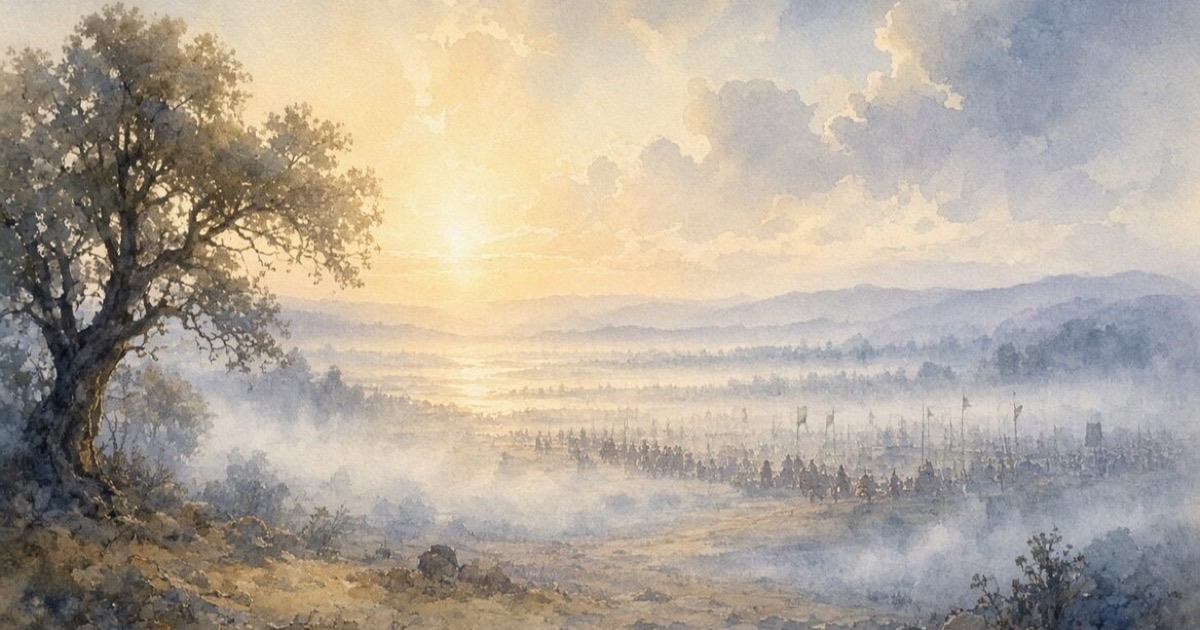
Notes on experiment 01, on how it is built and what the mathematics turned out to say. Read it afterwards.
- No. 02Talmudthe argument that must not be settled
- No. 03Attarthe thirty birds
- No. 04Zenthe question in the wrong basis